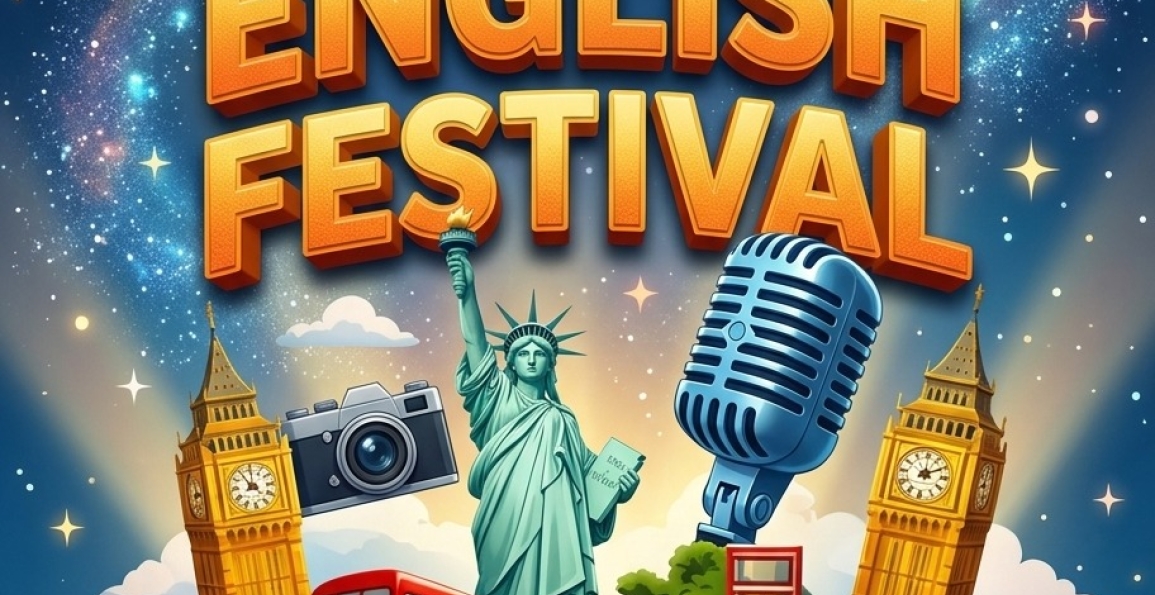
2026 Institutional English Festival: General Considerations and Pedagogical Guidelines

Dear English teachers,
Greetings.
In order to support the organization and pedagogical mediation of the 2026 Institutional English Festival, the following summary of relevant aspects contained in the 2026 English Festival Manual and Circular DVM-AC-DDC-0929-2026 is shared.
Please remember the importance of conducting a complete and careful reading of the official manual to ensure that the activities developed in each educational institution align with the pedagogical approach and guidelines established by the Ministry of Public Education.
Rationale
The Institutional English Festival emerges as a pedagogical strategy aimed at strengthening students’ communicative competence through the authentic and meaningful use of the English language in real or simulated contexts. This initiative responds to national educational policies, the action-oriented approach established in the current curricula, and the need to create spaces where students can interact, express themselves, collaborate, and demonstrate their language learning in creative, inclusive, and contextualized ways.
Likewise, the festival promotes students’ holistic development by strengthening communication skills, critical thinking, creativity, collaborative work, intercultural awareness, and confidence in the use of English.
Purpose of the Festival
The purpose of the Institutional English Festival is to provide students with opportunities to demonstrate the language competencies developed during the English teaching and learning process through meaningful communicative experiences aligned with the current curricula.
Additionally, the festival seeks to:
- Promote the authentic and functional use of English.
- Encourage students’ active participation in communicative contexts.
- Strengthen creativity, autonomy, and social interaction.
- Generate inclusive, participatory, and contextualized learning spaces.
- Foster motivation and enjoyment toward learning English.
Festival Description
The Institutional English Festival is a pedagogical, formative, and inclusive space designed for students from all levels and educational modalities within the public education system. Its purpose is to showcase the communicative learning developed in the classroom through authentic and contextualized activities that allow students to use English with communicative intent.
The festival is non-competitive in nature. Instead, it seeks to promote safe, collaborative, and motivating environments where students can demonstrate their language skills and progress in learning English.
Summary of General Guidelines
- The English Festival must be carried out according to the school calendar established by the MEP.
- The organization of the festival is the responsibility of English teachers in coordination with the educational community.
- The festival must maintain a formative and non-competitive approach.
- Activities must respond to the Action-Oriented Approach established in the current curricula.
- The authentic and functional use of English should be prioritized over mechanical memorization.
- Activities must be integrated into the regular pedagogical mediation carried out in the classroom.
- Inclusive and accessible processes must be guaranteed, considering the principles of Universal Design for Learning (UDL).
- All students must have opportunities to participate according to their abilities, learning styles, and learning pace.
- The festival may include activities previously developed in class such as mini-projects, dramatizations, presentations, storytelling, podcasts, videos, role plays, literary projects, oral presentations, debates, among others.
- Activities such as Spelling Bees do not correspond to the approach established for the 2026 English Festival.
- Artistic or musical activities must demonstrate communicative intent and meaningful use of English in coherence with the pedagogical approach of the festival. Therefore, dance activities alone do not correspond to the framework of the 2026 Institutional English Festival.
Pedagogical Guidelines by Educational Level
Early Childhood Education
In Preschool Education, the English Festival or Open House should be conceived as a language immersion experience in which English functions as a means of communication within meaningful, playful, and student-centered situations.
Activities should mainly promote:
- Emerging oral comprehension and production.
- Social interaction and symbolic play.
- Participation through gestures, movement, emerging language, and actions.
- Learning through meaningful experiences rather than mechanical repetition.
Suggested activities include:
- Daily routines.
- Simple role plays.
- Games.
- Environmental exploration activities.
- Storytelling.
- Expression of emotions.
- Songs with actions.
- Movement and dramatization activities.
The approach must be inclusive, flexible, and focused on the enjoyment and active participation of all children.
First and Second Cycles of Basic General Education
In primary education, the English Festival should allow students to use the language in authentic and contextualized communicative tasks according to their linguistic and cognitive development level.
Activities should:
- Foster oral and written interaction.
- Promote the functional use of English.
- Demonstrate learning developed in the classroom.
- Encourage creativity, participation, and confidence.
Suggested activities include:
- Mini-project presentations.
- Videos.
- Oral presentations.
- Podcasts.
- Storytelling.
- Posters and models.
- Role plays.
- Communicative stations.
- Digital stories.
In the First Cycle, guided interaction and emerging language use are prioritized, while in the Second Cycle, more structured oral productions and more complex communicative tasks are strengthened.
Third Cycle and Diversified Education
In secondary education, the English Festival should demonstrate the authentic use of English through communicative tasks, mini-projects, and experiences integrated into daily classroom work.
Students should use the language to:
- Interact.
- Solve problems.
- Express opinions.
- Argue ideas.
- Develop projects.
- Participate in meaningful communicative exchanges.
Activities may include:
- Mini-projects.
- Role plays.
- Contextualized songs.
- Literary projects.
- Spontaneous or guided interactions.
- Oral presentations.
- Debates.
- Podcasts.
- Dramatizations.
- Oral speeches.
- Videos.
Activities must be adjusted to the students’ linguistic level, educational modality, and corresponding exit profile, always maintaining the inclusive, pedagogical, and formative nature of the festival.
Final Consideration
Please remember that the 2026 Institutional English Festival should be understood as a natural extension of the pedagogical mediation processes developed in the classroom and not as an isolated activity focused solely on memorized or artistic performances.
The main objective is to promote authentic communicative experiences that allow students to use English in a meaningful, creative, and inclusive way while strengthening their confidence, participation, and holistic development.
For further details regarding the guidelines and pedagogical orientations, please conduct a complete reading of the 2026 Institutional English Festival Manual and Circular DVM-AC-DDC-0929-2026.
| Adjunto | Tamaño |
|---|---|
| MANUAL DE FESTIVAL DE INGLÉS 2026 (711.84 KB) | 711.84 KB |
| Circular DVM-AC-DDC- 0929-2026 Festival de Inglés 2026 (632.06 KB) | 632.06 KB |
| Sample Certificate for the DREA 2026 English Festival (522.76 KB) | 522.76 KB |